
If you are hiring a helper for the first time, the Work Permit is the document that makes it legal for her to live and work in your household. The Ministry of Manpower (MOM) calls this a Work Permit for a migrant domestic worker (MDW), and it used to be commonly referred to as the “FDW work permit,” a term some employers and older MOM materials still use interchangeably. In this guide, we use MDW throughout, in line with MOM’s current terminology, and cover exactly who qualifies, what you need to prepare, and how the application actually works.
This is a first-application guide. If your helper’s Work Permit is already active and you need to extend it, see our separate guide on how to renew a maid work permit.
Table of Contents
ToggleWhat Is the MDW Work Permit
The MDW Work Permit is issued under the Employment of Foreign Manpower Act and allows a foreign woman to be employed as a live-in domestic helper in a Singapore household. It is applied for, held, and renewed by the employer (the person who hires the helper), not by the helper herself. The permit is typically valid for up to two years, depending on the validity of the security bond, and must be renewed to keep the helper’s employment status legal.
Who Is Eligible to Hire an MDW (Employer Requirements)
Before you can apply, MOM requires that you, as the employer, meet these criteria:
- Be 21 years old and above.
- Not be an undischarged bankrupt.
- Have the mental capacity to fully understand and discharge your responsibilities as an employer.
- Have no medical condition that would impair your ability to supervise a helper.
MOM also considers your household’s care-giving needs, such as young children or elderly family members, and your financial ability to hire, maintain, and house the helper appropriately. For the fuller breakdown of these employer-side rules, see our criteria to hire a maid guide.
MDW Eligibility Criteria
The helper you are hiring must also meet MOM’s own eligibility rules:
- Age: between 23 and below 50 years old at the point of her first Work Permit application. Helpers aged 50 and above can only renew an existing Work Permit, up to age 60.
- Gender: female.
- Education: at least 8 years of formal education, backed by a recognised certificate.
- Nationality: from an approved source country, currently Indonesia, Philippines, Sri Lanka, Thailand, India, Bangladesh, Myanmar, Cambodia, Malaysia, Hong Kong, Macau, Taiwan, or South Korea.
Step-by-Step: How to Apply for the Work Permit
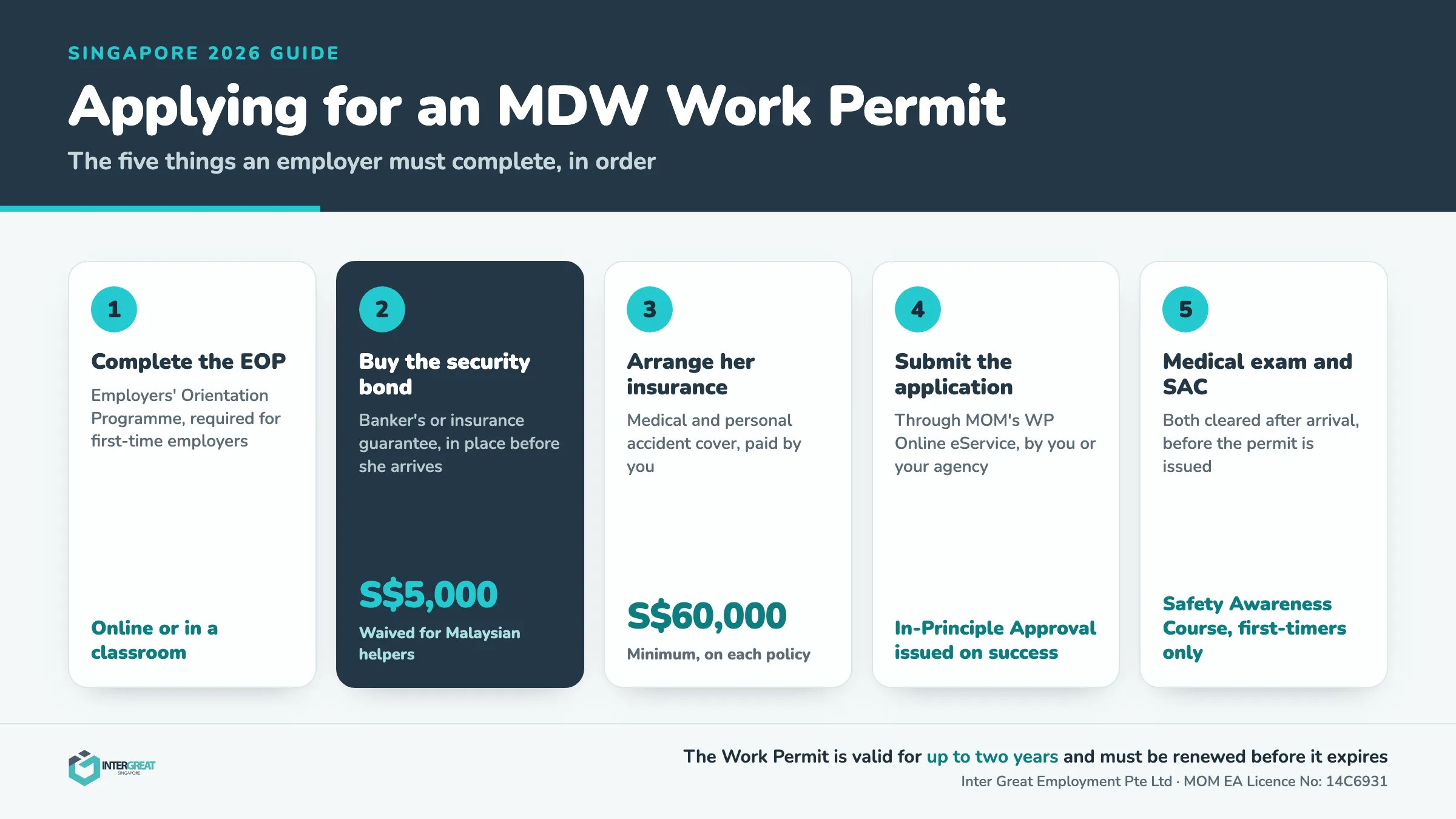
1. Complete the Employers’ Orientation Programme (EOP)
If this is your first time hiring an MDW, you must complete the EOP, available online or in a classroom setting, before you submit the Work Permit application. Certain employers, such as those with a chronic medical condition or aged 60 and above with physical discomfort, may apply for an EOP exemption.
2. Purchase the Security Bond
For every non-Malaysian helper, MOM requires a $5,000 security bond, in the form of a banker’s or insurance guarantee, as a binding pledge to the government if you or your helper breaches Work Permit conditions. It must be in place before your helper arrives, and processing with a bank or insurer can take a few working days, so arrange it early. Malaysian helpers are exempt. Full detail here: what is the security bond for a maid.
3. Buy Medical and Personal Accident Insurance
You must provide, at your own cost:
- Medical insurance (MI) with an annual claim limit of at least $60,000, covering inpatient care and day surgery for the duration of her stay.
- Personal accident insurance with a minimum sum assured of at least $60,000, covering death or permanent disability from sudden, unforeseen incidents.
These costs cannot be passed on to the helper.
4. Submit the Work Permit Application
Applications are submitted online through MOM’s WP Online eService, either by you as the employer or by your engaged employment agency on your behalf. Once approved, MOM issues an In-Principle Approval Letter or Letter of Notification, which allows your helper to travel to Singapore. For the complete walkthrough of the hiring process, from selecting a helper to her arrival, see how to hire a maid.
5. Medical Exam and Safety Awareness Course
After she arrives, your helper must pass a medical examination by a Singapore-registered doctor, and first-time helpers must attend the Safety Awareness Course, before the Work Permit is actually issued. During her employment, she will also need a Six-Monthly Medical Examination (6ME), screening for pregnancy and infectious diseases, unless she is aged 50 or above, in which case a medical exam is only required at renewal.
Ongoing Costs Employers Should Budget For
Beyond the one-time security bond and insurance, employers pay a monthly foreign domestic worker levy for as long as the Work Permit is active. MOM sets a standard rate and a lower concessionary rate for households that qualify (for example, families with young children or elderly members). Levy is paid via GIRO. We break down the current tiers in our maid levy guide, since these are government-set rates and can be revised in the annual Budget.
Work Permit Validity and Renewal
The Work Permit is generally valid for up to two years, tied to the validity of your security bond, and can be renewed before it expires. Since renewal has its own document checklist and timeline that differs slightly from a first application, we have kept that process in its own guide: how to renew a maid work permit.
Can I Hire a Second MDW?
Most households are limited to one MDW at a time, unless you meet MOM’s care-giving criteria for a second helper, such as you or your spouse being 60 years old or above, having at least two children under 18 living with you, or having a parent or parent-in-law aged 60 or above living in the household.
Where Inter Great Employment Comes In
Applying for a Work Permit correctly the first time avoids delays, rejected applications, and lapses in your helper’s legal status. Inter Great Employment Pte Ltd (MOM EA Licence No: 14C6931) handles the EOP guidance, security bond arrangement, insurance procurement, and the WP Online submission on your behalf, so you are not navigating MOM’s eServices alone. Speak to our team before you begin the application.
Get in touch with us today @ +65-97766988. Inter Great Employment Pte Ltd (MOM EA Licence No: 14C6931).
(Disclaimer by Inter Great: All above information and/or monetary figures are meant for reference only. Please refer to MOM’s official website for updated and accurate information, or approach and consult our recruitment consultant if you need professional advice and consultation.)
Frequently Asked Questions
Who is eligible to hire a migrant domestic worker in Singapore?
You must be 21 years old or above, not an undischarged bankrupt, have the mental capacity to supervise a helper, and be assessed by MOM as financially able to hire, maintain, and house her. First-time employers must also complete the Employers’ Orientation Programme before applying.
What is the security bond for an MDW, and how much is it?
It is a $5,000 banker’s or insurance guarantee required for every non-Malaysian MDW you hire, acting as a pledge to the government if Work Permit conditions are breached. It must be arranged before your helper arrives and is released after she leaves Singapore, provided there is no breach.
How much is the MDW levy each month?
MOM sets a standard monthly levy and a lower concessionary rate for qualifying households, such as those with young children or elderly family members. Levy is paid monthly via GIRO for as long as the Work Permit is active. Current tiers are covered in our maid levy guide, since MOM can revise these rates.
How long is an MDW Work Permit valid, and how do I renew it?
It is typically valid for up to two years, depending on your security bond’s validity. Renewal has its own checklist and timeline, which we cover in our separate guide on renewing a maid’s Work Permit.
Can I hire more than one MDW?
Generally no, unless you meet MOM’s criteria for a second helper, such as you or your spouse being 60 or above, having at least two children under 18 at home, or having an elderly parent or parent-in-law living with you.