
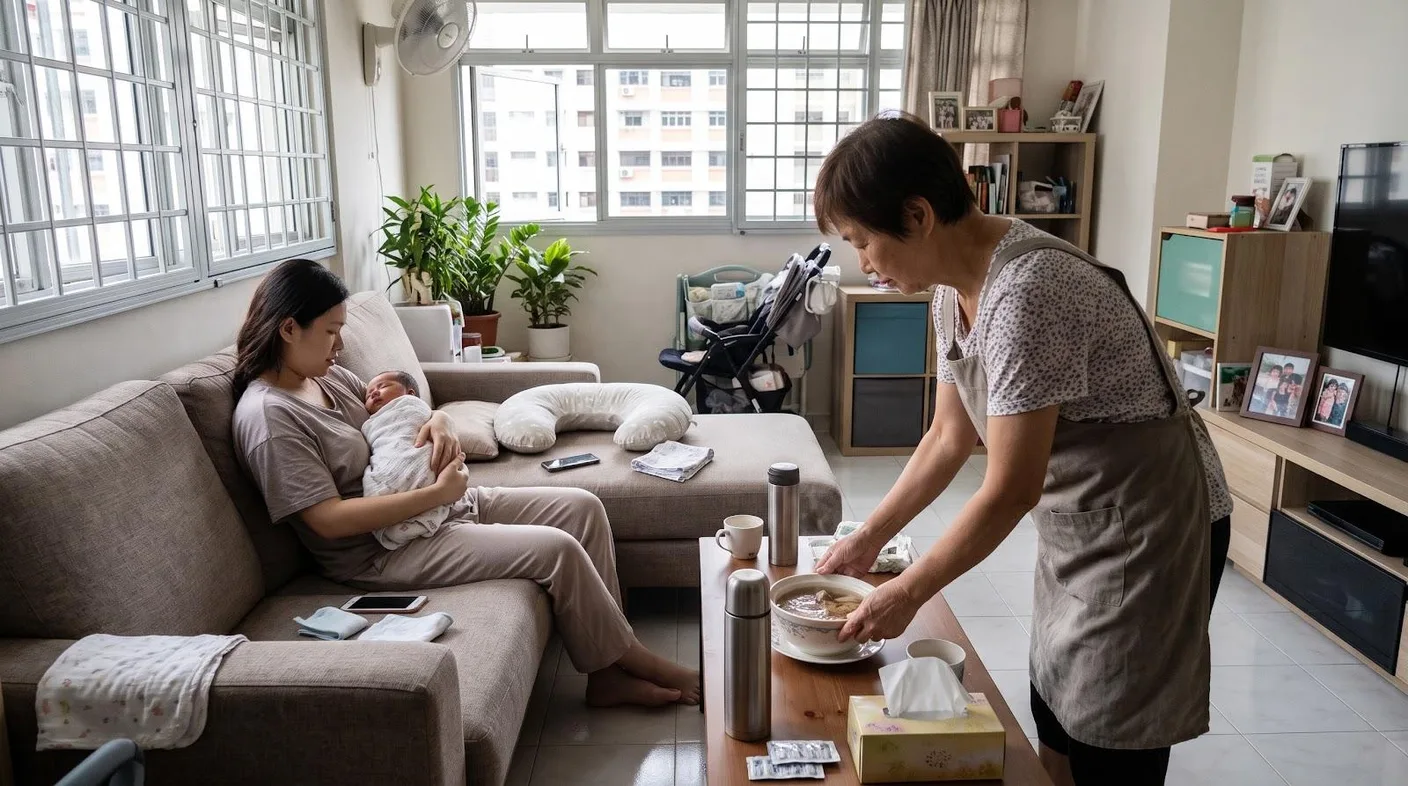
Most Singapore couples expecting a baby end up weighing the same two options for the weeks after the birth: a confinement nanny, sometimes called a confinement lady, who comes for the first month, or a live-in migrant domestic worker (MDW) who stays for two years.
They are not the same job, they are not on the same permit, and they do not stay for the same length of time. A confinement nanny is a short-term specialist whose work centres on the mother’s recovery and the newborn’s first weeks. An MDW is a long-term member of the household who is still there when maternity leave ends and both parents are back at work.
This guide sets out what each one does, how long each can legally stay, how the two can overlap, and which arrangement tends to fit which household. For transparency: Inter Great places migrant domestic workers. We do not supply confinement nannies, so where this guide covers them, it is to help you plan around them, not to sell them.
Quick answer: which one do you need?
A confinement nanny covers roughly the first 30 days: postnatal meals, newborn care and the mother’s rest. An MDW is a two-year arrangement for the household, the baby and everything after confinement. Many families use both, with the nanny for the first month and the MDW for what follows.
What a confinement nanny does in the first month
A confinement nanny looks after the mother and the newborn during the confinement period, usually the 28 days after the birth. Her work typically covers confinement meals and tonics, bathing and feeding support for the baby, overnight care so the mother can sleep, and light housework tied to the mother and baby.
On the newborn side, the work generally includes:
- Bathing the baby and caring for the umbilical cord stump.
- Bottle preparation and sterilising, and support with breastfeeding positions.
- Night feeds, burping and settling, so the mother gets unbroken sleep.
- Watching for jaundice, feeding problems and other signs the family should raise with the paediatrician.
What she generally does not do is run the whole household. Cleaning the flat, cooking for the rest of the family, or looking after an older child are often outside the arrangement or charged separately, and that varies from one nanny to the next. Ask what is included before you agree to anything.
Confinement nannies in Singapore are mostly Singaporean or Malaysian. A Singaporean nanny needs no work pass; a Malaysian nanny needs the Ministry of Manpower’s (MOM) Work Permit for confinement nanny, covered below.

What a live-in MDW can do with a newborn
A live-in MDW works for your household for the length of her Work Permit, up to two years and renewable. With a newborn, she can handle bottle preparation, sterilising, laundry, bathing and night help once she has been shown your routine, alongside the cooking, cleaning and errands for the whole family.
The difference from a confinement nanny is scope and duration rather than the newborn tasks themselves. What she brings that a confinement nanny does not is continuity: she is still there in month four, when the parents return to work, and in year two, when the baby is a toddler.
What she may not bring is confinement cooking. Some MDWs can follow a confinement menu once shown; many have not cooked one. If confinement food matters to your family, plan for it separately rather than assuming the helper will know it.
Experience with newborns varies a great deal between candidates, and it is the single most important thing to screen for when the baby is the main reason you are hiring. Our page on infant and child care helpers explains how we check a candidate’s childcare history and what to ask at an interview.
How long each one can stay
A Malaysian confinement nanny’s Work Permit lasts at most 16 weeks from the baby’s date of birth and cannot be renewed. An MDW’s Work Permit lasts up to two years, depending on the security bond, and can be renewed. In practice most confinement arrangements run for 28 days, and most MDW contracts run for two years.
The 16-week limit is a legal ceiling, not the usual booking. MOM’s rules also require the baby to be under four months old for the permit to be issued, and an application made after the birth gets a shorter validity, since the 16 weeks still count from the date of birth. If you need help beyond that window, MOM directs employers to the MDW Work Permit instead.
- Permit: Work Permit for confinement nanny; Work Permit for MDW
- Maximum duration: 16 weeks from the baby’s birth; Up to 2 years
- Renewable: No; Yes
- Nationality: Malaysian only; Approved source countries, including the Philippines, Indonesia and Myanmar
- Age at application: 23 to below 70; 23 to below 50 (first permit)
- Employer conditions: Aged 21 or above, baby under 4 months; Aged 21 or above, Employer Orientation Programme for first-time employers
- Monthly levy: $60 if the baby is a Singapore citizen, $300 if not; $300 standard, $60 concessionary for qualifying households
- Medical insurance: Required, at least $60,000 annual cover; Required, at least $60,000 annual cover, plus personal accident cover of at least $60,000
- Security bond: Not listed in MOM’s confinement nanny requirements; $5,000 for non-Malaysian MDWs
A Singaporean confinement nanny is outside this table entirely, because she does not need a work pass. If a nanny of any nationality other than Malaysian is offered to you, ask the provider which pass she will be working on. The confinement nanny permit is for Malaysian nationals only.
Having a confinement nanny and a helper at the same time
Yes, a household can have both. MOM’s confinement nanny rules provide for an employer who already has an MDW registered under their name: the two levies are combined into one monthly GIRO deduction. The nanny works at your residence for the confinement weeks, and the MDW carries on with the household around her.
This is the arrangement many dual-income couples settle on, and it works well when the roles are split clearly from the first day. A workable division usually looks like this:
- The confinement nanny takes the mother’s meals, the baby’s baths and the night feeds.
- The MDW takes the household: the rest of the family’s meals, cleaning, laundry, groceries and any older children.
- Both share the baby’s daytime care, so the MDW learns the routine she will run on her own once the nanny leaves.
That last point is the main reason to overlap them. When the nanny leaves on day 28, the handover is to someone who has spent four weeks learning your baby’s routine, not to a new arrival.
Two practical points. First, space: a confinement nanny usually sleeps in or near the nursery, and an MDW needs acceptable accommodation of her own, so check if your flat can house both for a month. Second, the order of arrival: if the MDW is new, have her arrive a few weeks before the due date where you can, so she has settled in before the household changes around her.
What drives confinement nanny cost, and what the Government charges
Confinement nanny fees are set privately by each nanny or agency. The main drivers are the length of the booking, live-in or daytime hours, the number of babies, festive periods, the nanny’s experience and what is included. A Malaysian nanny also brings government charges: the application fee, the monthly levy, and medical insurance, which is bought as a one-off premium for the policy period.
What tends to push the fee up or down:
- Length. A 28-day booking costs more than a 14-day one, and extensions are usually charged per day.
- Live-in or daytime. A live-in nanny covering nights costs more than a daytime-only arrangement.
- Twins or more. Multiple babies usually carry a higher rate.
- Timing. Bookings over festive periods, Chinese New Year in particular, are often charged at a premium.
- Experience and references. Nannies with long track records and strong references are in more demand.
- Inclusions. Whether cooking for the rest of the family, housework or an older child is included, or charged separately.
What the Government sets, for a Malaysian nanny:
- An application fee of $35.
- A monthly levy of $60 if the baby is a Singapore citizen, or $300 if not.
- Medical insurance with at least $60,000 of annual cover, which the employer buys.
Ask every provider for an itemised quote that separates the nanny’s fee from the permit, levy and insurance, and confirms who is applying for the permit. Some quotes include the government items and some leave them to you, which is the most common reason two quotes that look similar are not.
For the MDW, a Singapore citizen child under 16 living at the same address qualifies the household for the concessionary levy of $60 a month in place of the standard $300. Our guide to the maid levy in Singapore explains how the concession is applied and paid.
Which arrangement fits your household
A confinement nanny alone fits a household where one parent or a grandparent will be home after confinement. An MDW alone fits a household that needs help from birth through the return to work and has no strong need for confinement cooking. Both together fit dual-income couples who want specialist care in month one and continuity afterwards.
A confinement nanny alone makes sense when the confinement month is the only gap. A mother taking extended leave, or a grandparent ready to step in from week five, means the household does not need anyone beyond 28 days. The nanny covers the hardest weeks, then leaves.
An MDW alone makes sense when the household needs help well beyond the first month and confinement cooking is not a priority, or a family member will handle it. An MDW with genuine infant experience can cover the newborn weeks herself, and she is still there when both parents go back to work. Screen hard for that infant experience, because it is doing the job a confinement nanny would otherwise do.
Both together makes sense for the household most likely to be reading this: both parents returning to work when maternity leave ends, no grandparent is able to take on full-time care, and a wish for confinement to be done properly. The nanny handles month one, the MDW learns alongside her, and by the time the nanny leaves, the person who will care for your baby every day already knows how.
When to arrange each one before the due date
Book a confinement nanny early in the pregnancy, because her dates are tied to your due date and cannot easily move. The Malaysian nanny’s Work Permit can be applied for from four weeks before the expected delivery date. Start looking for an MDW well before the due date too, so she has arrived and settled in before the baby comes.
A workable order, for a household planning to use both:
- Second trimester. Book the confinement nanny and confirm in writing the dates, inclusions and who applies for the permit.
- Second to early third trimester. Start the MDW search. Shortlist candidates with infant experience and interview them on it specifically.
- Four weeks before the due date. The confinement nanny’s Work Permit application can be made from this point. MOM usually processes it within a week.
- Before the birth. The MDW arrives, attends the Settling-In Programme if she is new to Singapore, completes her medical examination and learns the household.
- Birth to day 28. Both work together, with the split of duties agreed up front.
- Day 28 onwards. The confinement nanny leaves, and her Work Permit is cancelled within one week of her leaving Singapore. The MDW carries on.
The MDW side has more steps: matching, the Work Permit, insurance, the security bond and the arrival programme. Our guide on how to hire a maid in Singapore walks through each one in order. If you would rather have the process handled for you, a licensed maid agency in Singapore can shortlist candidates with newborn experience and manage the paperwork, so the search does not land in the same weeks as the birth.
Summary
A confinement nanny and a migrant domestic worker do different jobs on different timelines. The nanny is a short-term specialist for the mother and the newborn, usually for 28 days and never beyond 16 weeks from the birth on a Malaysian Work Permit. The MDW is a two-year arrangement for the whole household, and she is still there when maternity leave ends. MOM’s rules allow a household to have both at once, with the two levies combined into one deduction.
For most dual-income couples the practical answer is to overlap them: the nanny for the first month, the MDW alongside her and then on her own. If you are planning the MDW side and want help finding a candidate with real infant experience, you can speak to one of our consultants about timing and shortlisting before the due date. Inter Great has placed MDWs with Singapore families since 2013, through branches in Ang Mo Kio, Katong and Bugis.
Get in touch with us today @ +6597766988. Inter Great Employment Pte Ltd (MOM EA Licence No: 14C6931). Follow us on Instagram and Facebook.
(Disclaimer by Inter Great: All above information and/or monetary figures are meant for reference only. Please refer to MOM’s official website for updated and accurate information, or approach and consult our recruitment consultant if you need professional advice and consultation.)
Frequently Asked Questions About Confinement Nannies In Singapore
How long can a confinement nanny stay in Singapore?
A Malaysian confinement nanny’s Work Permit lasts at most 16 weeks from the baby’s date of birth and cannot be renewed. Most families book for 28 days. If you need help beyond 16 weeks, MOM directs employers to the migrant domestic worker (MDW) Work Permit instead.
Can I hire a confinement nanny if I already have a helper?
Yes. MOM’s rules provide for an employer who already has an MDW registered under their name, and the two monthly levies are combined into one GIRO deduction. Many families use the overlap so the helper learns the baby’s routine before the nanny leaves.
What is the levy for a confinement nanny?
The levy is $60 a month if the newborn is a Singapore citizen and $300 a month if not. There is also a $35 application fee, and the employer must buy medical insurance for her.
Can a confinement nanny come from China or other countries?
MOM’s Work Permit for confinement nanny is for Malaysian nationals only. Singaporean confinement nannies do not need a work pass. If a nanny of any other nationality is offered, ask the provider which pass she will be working on.
How much does a confinement nanny cost in Singapore?
Fees are set by each nanny or agency and depend on the length of the booking, live-in or daytime hours, twins, festive periods and what is included. Ask for an itemised quote that separates the nanny’s fee from the Government’s $35 application fee, the monthly levy, and medical insurance, which is bought as a one-off premium for the policy period.