
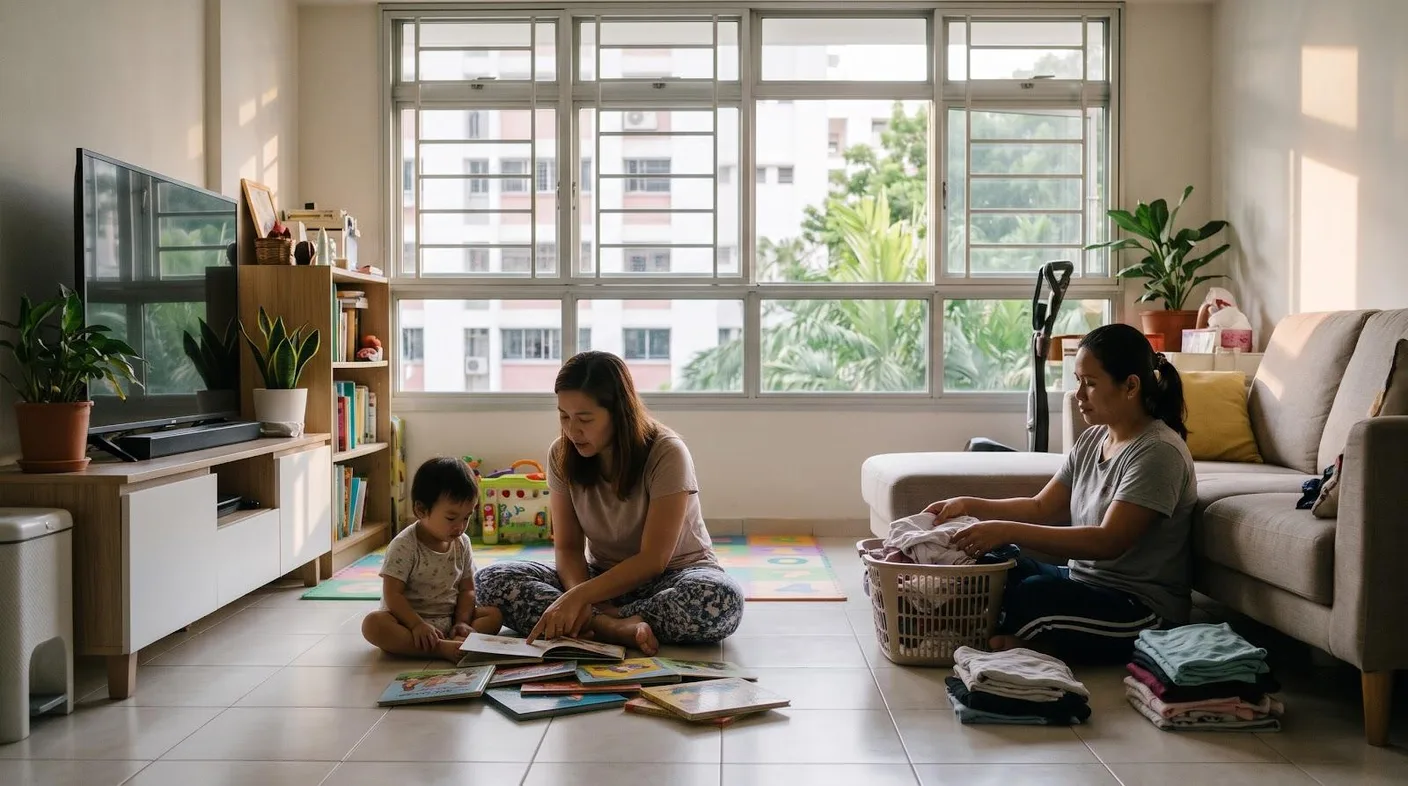
Most parents searching for a babysitter in Singapore want the same thing: someone reliable to watch the children for a few hours, a few evenings a week, or for the gap between the end of school and the end of the working day. The words used for that person vary. Babysitter, nanny, part-time helper and childminder are used interchangeably in conversation and in WhatsApp groups.
The law does not treat them interchangeably. Whether an arrangement is legal depends less on what the person is called than on who they are and what pass they hold. A Singaporean neighbour can babysit for you tomorrow. A migrant domestic worker (MDW) employed by the family next door cannot, even for one evening, even with her employer’s permission and even if she is paid well for it.
This guide sets out who may lawfully look after your children part-time, what happens when a household gets it wrong, and when a live-in MDW is the lawful full-time answer.
Quick answer: who can you legally employ to look after your children?
Singapore citizens and PRs may babysit without a work pass. Foreigners need a valid work pass or a specific exemption. An MDW may only work for her own employer at the address on her Work Permit, so she cannot babysit for anyone else. Full-time care is her lawful role.
Who can legally babysit or nanny in Singapore?
A Singapore citizen or permanent resident may be engaged as a babysitter or nanny without a work pass. A foreigner may only work if she holds a valid work pass or falls within a published exemption, and the household paying her is exposed if she does not.
In a written answer to Parliament in November 2020, the Ministry of Social and Family Development said there are no specific regulations for small-scale, home-based care services, and advised parents to know their caregivers and carry out their own checks, including references from previous families. The checking is on you.
The work pass question is where most of the legal risk sits. The table sets out the people parents most often consider.
- Singapore citizen or permanent resident: Yes; No work pass needed
- Full-time student on a Student’s Pass at an institution on MOM’s approved list: Only within MOM’s limits; Up to 16 hours a week during term, without a work pass; vacation work allowed from age 14
- Exchange student: No; MOM states exchange students are not allowed to work
- Dependant’s Pass holder: Not without her own work pass; Since May 2021, Dependant’s Pass holders need a Work Permit, S Pass or Employment Pass to work
- Long-Term Visit Pass holder married to a Singapore citizen or PR: Only with a Letter of Consent; The employer must receive the Letter of Consent before she starts
- Someone else’s MDW: No; Her Work Permit covers one employer and one address only
- Your own MDW: Yes, for your own children at your address; This is what her Work Permit is for
On the student row, the exemption covers only full-time students at institutions on MOM’s list. If you are unsure, ask to see the pass and check the institution against that list before the first booking.
Can a migrant domestic worker babysit part-time for another family?
No. MOM states that it is an offence for an MDW to take part-time employment, with or without her employer’s consent. Her Work Permit allows her to do household work only for her employer at the residential address stated on it. Babysitting a neighbour’s children, on her rest day or otherwise, is work for another employer and is not allowed.
The rule exists to stop MDWs being worked across several households. Her agreement, her employer’s agreement and extra pay do not make an arrangement lawful.
MOM spells out several situations that employers assume are acceptable and are not:
- She may not work for another household or another employer, including on her rest days, which are hers to rest (our guide to maid off days and working hours covers what employers must provide).
- She may not clean a parent’s flat or another property, even occasionally and even if she is compensated for it.
- She may not work for her employer’s business, even a business run from home.
- Her employer may not apply for an MDW in his own name and then let her work for a relative. If the relative needs a helper, the relative has to be the employer.
Asking a friend’s helper to mind your children for an evening is therefore not a favour between families. In law it is employing a foreigner without a valid work pass for that work.
What are the penalties for getting it wrong?
Penalties fall on all three parties. Whoever hires someone else’s MDW faces a fine of $5,000 to $30,000, up to 12 months’ jail, or both. Her own employer faces a penalty of up to $10,000 and a possible bar on employing helpers. The MDW risks a fine of up to $20,000, two years’ jail, or both.
- The household that pays another family’s MDW: Employing a foreigner without a valid work pass; Fine of $5,000 to $30,000, imprisonment of up to 12 months, or both. Repeat offenders face mandatory imprisonment of 1 to 12 months and a fine of $10,000 to $30,000
- The MDW’s own employer: Failing to ensure she does only domestic work at the registered address; Financial penalty of up to $10,000, and may be barred from employing MDWs
- The MDW: Working without a valid work pass; Fine of up to $20,000, imprisonment of up to two years, or both
MOM enforces this. In July 2024 MOM charged an individual with 33 counts of employing foreigners without valid work passes, after allegedly arranging part-time cleaning work through a Viber chat group between 2018 and 2021. Of the 33 foreigners, 27 were MDWs.
Which everyday arrangements break the rules?
Most breaches are not deliberate. They happen because an arrangement feels like ordinary family help. Your helper caring for your own child at the grandparents’ home is allowed once MOM is notified. Almost every other arrangement that sends her to another household, or brings another household’s work to her, is not.
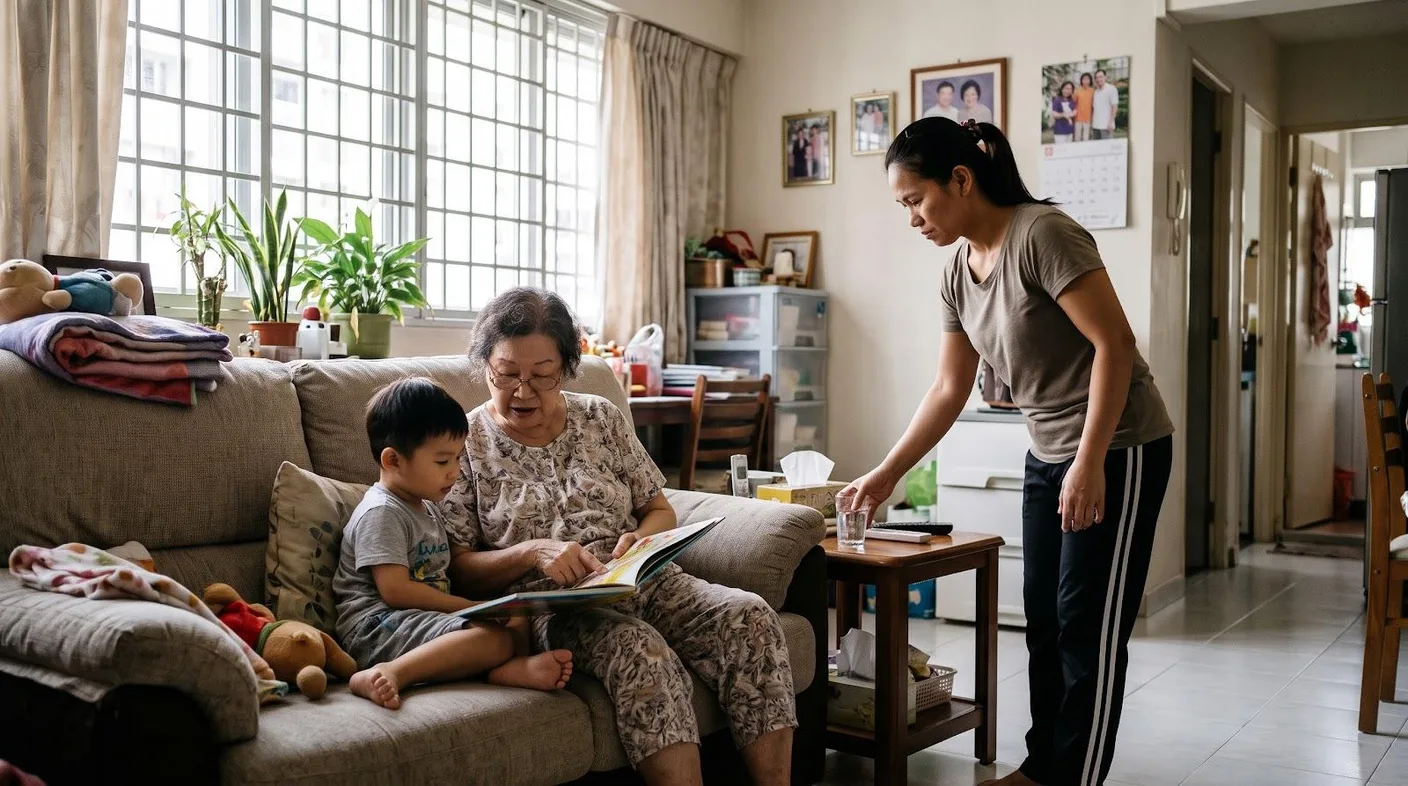
Your helper looks after your child at the grandparents’ flat. This is allowed, with conditions. MOM permits an MDW to care for her employer’s child or parent at a relative’s home if the employer notifies MOM before the arrangement starts, has her written agreement, and makes sure she is not carrying the full housework load of both households. If she stays overnight, the accommodation there must meet MOM’s requirements. You remain responsible for her upkeep throughout.
Your helper minds your sister’s children at your sister’s home. The relative’s-home allowance covers the employer’s own child or parent. It does not extend to a relative’s children in the relative’s household. If your sister needs a helper, she has to employ one.
Two families share one helper. This is not possible under one Work Permit. Each household that wants an MDW must be her employer in its own right.
A friend’s helper babysits on her rest day. This is employing someone else’s MDW, whatever the amount paid and however short the time.
Your helper also helps in the family business. Not allowed, even if the business runs from home, even if the work is light, and even if she is paid extra.
What are the lawful options for part-time or occasional childcare?
For a few hours here and there, the lawful routes are a Singapore citizen or PR sitter you engage directly, an eligible student within MOM’s hours, or a care provider whose own carers you book. For infants, there is also a government-supported childminding pilot. A shared or borrowed MDW is never one of the options.
A citizen or PR babysitter. This is what most parents end up with, through a friend, a babysitting platform or a nanny service. No work pass is involved. Because home-based babysitting is unregulated, do your own checks: references from previous families, a trial session while you are at home, and clear agreement on duties.
ECDA’s childminding pilot for infants. The Early Childhood Development Agency runs a pilot from 1 December 2024 to 31 December 2027 for Singapore citizen infants aged 2 to 18 months who are not also enrolled in a licensed infant care centre. Care is given by childminders in their own homes or in community spaces, each looking after one to three infants, through three appointed operators. ECDA carries out background checks on the childminders before they are deployed.
Household Services Scheme companies. Under this MOM scheme, approved companies employ migrant workers to provide part-time household services such as home cleaning, and selected companies provide basic elder-minding. Basic child-minding was added in a 2023 pilot, but MOM has said it is no longer supported with manpower concessions under the pilot from March 2026. Do not assume a company still offers it; check.
A confinement nanny after the birth. A Malaysian confinement nanny can be employed on a short-term Work Permit, usually issued for up to 16 weeks from the birth of the child. This covers the confinement period, not ongoing babysitting.
When is a live-in helper the lawful answer?
When you need someone on hand every working day, for most of the day, a live-in MDW you employ yourself is the lawful full-time option. She works only for your household, at your address, which is precisely what her Work Permit allows. That is the arrangement households try to imitate when they borrow a neighbour’s helper.
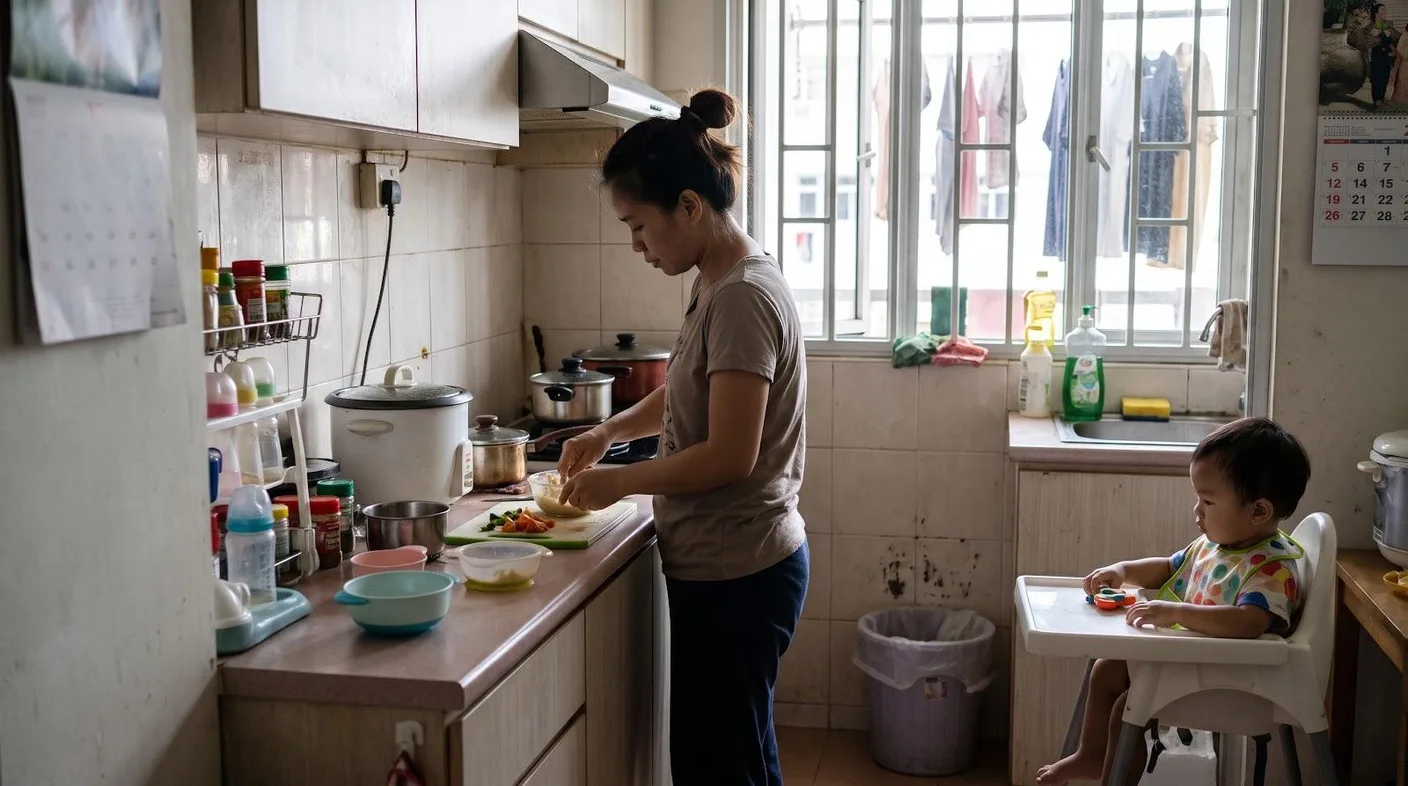
The case is strongest for dual-income parents returning to work after maternity leave, and for households whose need runs to early mornings, late evenings or a parent who travels. Hourly babysitting does not cover those well.
A few rules shape the decision:
- Your home has to accommodate her. She must live at the address on her Work Permit, in accommodation that meets MOM’s requirements. Plan the sleeping arrangement before she arrives.
- You have to qualify as an employer. MOM sets the employer criteria. Our guide to the criteria to hire a maid in Singapore sets them out.
- The levy is lower with a young child. The standard monthly levy for a first MDW is $300. Where the household includes a Singapore citizen child below 16, the concessionary rate is $60 a month, and MOM grants it automatically. For parents, it runs from the child’s date of birth.
- She cannot be deployed to work for others. She works for your household only.
How the permit itself is applied for, renewed and cancelled is covered in our guide to the MDW Work Permit.
If a newborn or toddler is the reason you are hiring, experience with young children is the first thing to screen for. Our infant and child care helper page explains how we shortlist for it, and our maid agency in Singapore page sets out how a placement runs from first enquiry to her first week.
Babysitter, nanny or helper: which one fits your situation?
The right choice depends on how many hours you need, how predictable they are, and whether you can house someone. Occasional evenings suit a citizen or PR babysitter. Regular infant care on weekdays may suit a childminder. Full-time, every-day care with early starts and late finishes is the arrangement a live-in MDW is designed for.
- One or two evenings a month: Citizen or PR babysitter; References and a trial session
- A few afternoons a week after school: Citizen or PR sitter, or an eligible student within 16 hours a week; Student’s Pass status and institution, if she is a student
- Weekday care for a Singapore citizen infant aged 2 to 18 months: ECDA childminding pilot; Eligibility and operator availability near you
- The first weeks after birth: Confinement nanny on a short-term Work Permit; Permit timing around the due date
- Full-time care while both parents work: Your own live-in MDW; Accommodation, employer criteria, levy concession
- Grandparents care for the child and need support: Your own MDW, with MOM notified if she works at their home; Written agreement and MOM notification before it starts
Summary
Babysitter, nanny and helper are interchangeable words but not interchangeable arrangements. Singapore citizens and PRs may babysit without a work pass, students may work only within MOM’s limits, and an MDW may work only for her own employer at the address on her Work Permit. Paying someone else’s helper to babysit, even for an evening on her rest day, exposes the household that pays her, her employer and the helper herself to penalties that MOM enforces.
For occasional hours, engage a citizen or PR sitter and check references. For full-time care, a live-in MDW employed by your own household is the lawful arrangement, and the levy concession for a young Singapore citizen child applies automatically. If you are weighing up whether your household needs one, speak to our consultants about your childcare hours before you decide, or read more about Inter Great.
Get in touch with us today @ +6597766988. Inter Great Employment Pte Ltd (MOM EA Licence No: 14C6931). Follow us on Instagram and Facebook.
(Disclaimer by Inter Great: All above information and/or monetary figures are meant for reference only. Please refer to MOM’s official website for updated and accurate information, or approach and consult our recruitment consultant if you need professional advice and consultation.)
Frequently Asked Questions About Babysitters And Nannies In Singapore
Can my helper babysit for other families in Singapore?
No. An MDW may only do household work for her own employer at the residential address on her Work Permit. MOM states it is an offence for her to take part-time employment, with or without her employer’s consent, and that includes work on her rest day.
Can I hire a foreigner as a part-time nanny in Singapore?
Only if she holds a valid work pass or falls within a published MOM exemption. Employing a foreigner without a valid work pass carries a fine of $5,000 to $30,000, imprisonment of up to 12 months, or both.
Can a student babysit in Singapore?
A Singapore citizen or PR student can. A foreign student on a Student’s Pass may work without a work pass only if she is a full-time student at an institution on MOM’s list, for up to 16 hours a week during term. Exchange students are not allowed to work.
What is the difference between a nanny and a babysitter in Singapore?
In everyday use a nanny usually provides regular, longer care and a babysitter covers occasional hours, but neither term has a legal meaning. Whether either is lawful depends on who she is, what pass she holds and who employs her.
Can my helper look after my child at my parents’ home?
Yes, if you notify MOM before the arrangement starts, have her written agreement, and make sure she is not doing the full housework of both households. If she stays overnight, the accommodation must meet MOM’s requirements.